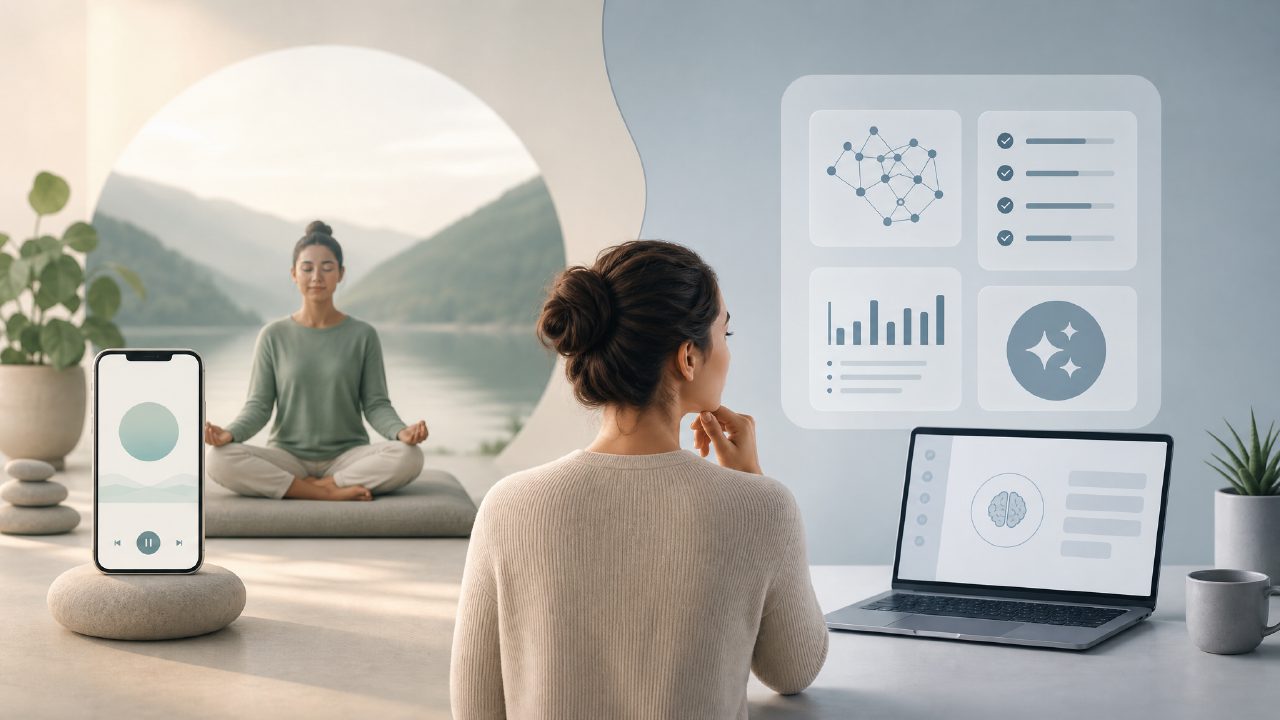
Meditation apps vs. a daily AI toolkit: which actually sticks?
I've tried more meditation apps than I care to admit. Headspace, Calm, a handful of obscure ones that promised "scientifically optimized" sessions. They all work—for about ten days. Then the notifications start feeling like chores, and the guided voice starts grating. So when I came across zaso.ai, which isn't a meditation app at all but a set of six focused AI tools for daily life, I was skeptical that it could help with something as personal as building a meditation habit.
But the pitch is different: instead of a do-everything Super App, zaso gives you small tools, each doing one thing well. I wanted to see if that modular approach could outperform the typical all-in-one meditation experience. So I ran a two-week head-to-head: my usual guided meditation app versus using zaso's tools to build a more flexible, self-directed practice.
The friction that killed my old habit
Most meditation apps force you into their structure. You pick a length, a voice, a theme. If it doesn't match your mood that day, you skip it—and then you feel guilty. Over time, the structure becomes friction.
With zaso, I started using its Daily Planning tool to block out five minutes of quiet time, not necessarily "meditation" in the formal sense. The tool itself is just a lightweight planner, but setting that intention shifted something. I wasn't opening a meditation app; I was opening my daily plan and seeing a slot labelled "sit quietly." That subtle reframe made it easier to follow through.
What actually worked better
The biggest surprise was how the Digital Journal tool replaced the post-meditation reflection that often felt forced in other apps. After five minutes of silence, I'd jot down a sentence or two—no prompts, no "how did that feel?" scoring. Just raw notes. Over two weeks, that built a small Personal Knowledge collection about what actually calms me: sitting by the window, not closing my eyes entirely, focusing on birdsong. No meditation app had given me that insight because they never asked for unstructured reflection.
Another unexpected win: the Life Management tool helped me tag different meditation attempts by context (morning, work break, evening commute substitute). After a week, I could see that my morning sessions were twice as consistent as evening ones. That's not a feature you get in Calm or Headspace unless you manually track it elsewhere.
Where the comparison broke down
Let's be fair—zaso is not a meditation app. It doesn't have guided sessions, breathing exercises, or ambient sounds. If your primary need is someone telling you to "notice the sensation of your breath" for ten minutes, a dedicated meditation app will do that better. Zaso's tools are facilitators, not instructors.
But that's also its strength. I found that using zaso as a Productivity System for my mental habits forced me to own the practice rather than outsourcing it. The combination of Workflow Management (build a repeatable process for daily quiet time) and the journaling piece created a loop that felt sustainable—less like a meditation regimen and more like a self-experiment.
One realistic friction: because zaso's tools are separate, you have to jump between them. There's no unified dashboard that says "your meditation streak is X days." For some that's liberating; for others it's a missing accountability feature. I missed the streak counter for two days, then realized I didn't actually care.
Who should consider this approach
If you've bounced off multiple meditation apps because they feel too prescriptive or too gamified, zaso's modular approach is worth testing. It won't teach you meditation, but it can help you build a personalized, low-friction ritual that fits into your existing Life Management routines.
If you need structure and guidance, stick with a dedicated app. But if you're tired of apps that treat meditation like a course with modules, try the opposite: use a tool that doesn't care how you meditate, only that you make space for it.
Final take
After two weeks, I'm not abandoning guided meditation entirely—I still use a timer app for breath counts. But the core habit of daily quiet time is now woven into my Daily Planning and Digital Journal. The zaso suite didn't replace meditation tools; it replaced the need for them. That's a more honest recommendation than calling it a "meditation app" ever could be.
Comments
Leave a Comment