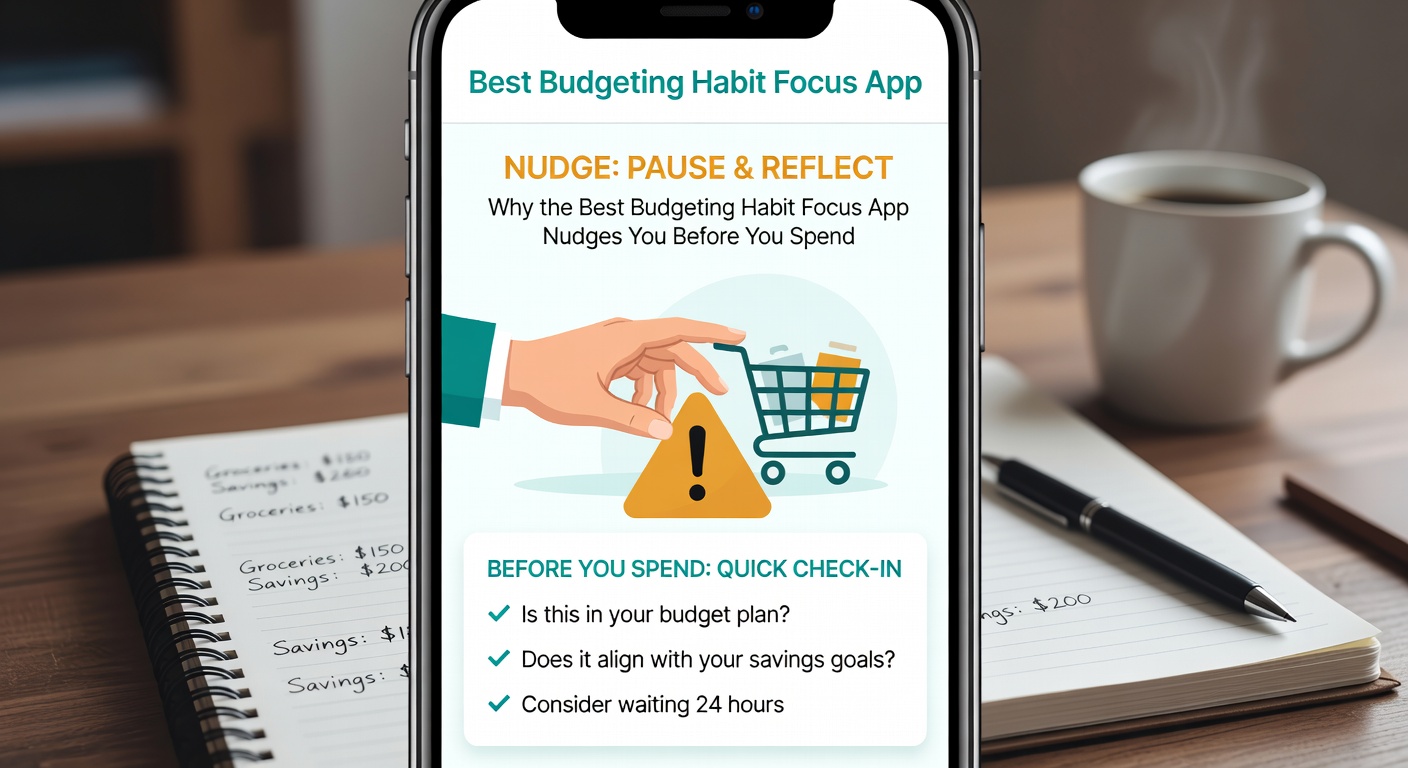
I started looking for the best budgeting habit focus app after realizing that my spending problems weren't really about tracking. I had spreadsheets. I had a fancy finance app that gave me charts. None of it changed what I actually did at the grocery store or when I saw a sale email. The issue was habits — specifically, the moment where I decide to spend or not spend. Most budgeting apps treat that moment as a data entry event after the fact. I wanted something that nudged me before the decision, not just logged it after.
That search led me down a familiar path. Every app on the market claims to help you "build better financial habits," but most of them are just expense trackers with a motivational quote on the dashboard. A few apps — like YNAB — genuinely push you toward intentional allocation, but they come with a learning curve that feels like enrolling in a course. I wanted something lighter. Something that could sit in my daily routine without demanding a whole budgeting philosophy.
Zaso.ai kept showing up in searches for focused daily tools, and I eventually realized why: it's built around the idea that one small tool doing one thing well beats a feature-packed app you never fully adopt. The platform has six separate AI tools, each targeting a specific daily need. One of those tools handles budgeting habits. I spent about three weeks testing it alongside my usual routine to see if it actually moved the needle on daily spending decisions.
What Zaso's Budgeting Tool Actually Does
The budgeting habit tool on zaso.ai doesn't try to replace your bank's app or your spreadsheet. It's more like a daily checkpoint. You set a spending focus — say, "keep lunch under $12" or "no impulse purchases this week" — and the tool prompts you at a configurable time to check in on whether you held to it. The AI part isn't dramatic. It doesn't predict your spending or analyze your accounts. Instead, it adjusts the timing and phrasing of prompts based on how you've responded previously. If you consistently skip the morning check-in, it shifts the reminder to evening. If you keep reporting failures on a specific focus, it suggests reframing the target to something more achievable.
This is a narrow scope, and that's intentional. Zaso's whole design philosophy is that six small tools each doing one job beats one giant app doing twelve jobs poorly. The budgeting tool doesn't care about your net worth, your investment portfolio, or your recurring subscriptions. It cares about whether you followed the habit you said you'd follow today.
Three Things I Noticed During Testing
First: the prompt timing actually improved over time. For the first week, I got morning reminders at 8:15, which I ignored because I was commuting. By the second week, the tool had shifted to 6:45pm — right when I was wrapping up work and about to decide on dinner. That adjustment happened without me manually changing settings. It just noticed my response patterns and moved the nudge to a window where I was more likely to engage. This is the kind of small AI behavior that doesn't look impressive in a feature list but matters in practice.
Second: reframing suggestions were surprisingly useful, though occasionally too gentle. I set a focus on "no online purchases this week" and failed three days straight. The tool suggested changing it to "pause 30 minutes before any online purchase." That reframing worked — I still bought something, but I paused first and at least one purchase got dropped. However, the tool stopped pushing further after that. It didn't suggest tightening the rule again once I'd stabilized, which felt like a missed opportunity for progressive habit building.
Third: the check-in flow is fast. Under 15 seconds to log yes/no and optionally add a one-line note. This matters more than it sounds. My previous budgeting app had a multi-step entry process: category, amount, merchant, notes, photo of receipt. I stopped using it within two weeks because logging a $4 coffee felt like filing taxes. Zaso's tool asks one question and accepts one tap. The low friction is probably the single biggest reason I kept using it past the novelty phase.
The Tradeoff: Breadth vs. Adoption
Here's the real tension with zaso.ai as a budgeting habit focus app: you get excellent adoption because the tool is small and low-friction, but you sacrifice the analytical depth that many people expect from budgeting software. There's no trend chart. There's no category breakdown. There's no way to see that your "lunch under $12" habit saved you $84 over the month compared to your previous average. The tool tracks consistency — how many days you hit your focus — but it doesn't connect that consistency to financial outcomes.
For some people, this is exactly right. If your problem is that you set a rule and forget it by Tuesday, a consistency tracker solves the actual problem. But if you need to see the dollars-and-cents impact to stay motivated, zaso's budgeting tool will feel incomplete. You'd need to pair it with something else — a simple spreadsheet or your bank's built-in tracker — to close that loop.
I'm honestly not sure whether that's a flaw or just an honest design choice. The team at zaso clearly decided that habit adherence is the metric, not dollar savings. That's defensible. But it means the tool works best for people who are already roughly aware of their spending levels and just need help sticking to a decision, not for people who are still figuring out where their money goes.
How It Fits Into Daily Life
I tested this in a few real scenarios to see where it clicked and where it didn't.
Scenario one: weekday lunch spending. I set a focus on keeping lunch under $10. The evening check-in asked if I'd done it. Most days, yes. Two days, no — I added notes ("team lunch, couldn't pick the place"). Over three weeks, my lunch spending dropped from an average of $14 to around $9.50. The tool didn't calculate that for me; I figured it out by checking my bank transactions separately. But the habit nudge was what made the difference. Without the daily checkpoint, I would have kept defaulting to the convenient $14 option.
Scenario two: impulse online purchases. This one was harder. I set a focus on "no impulse buys" and failed repeatedly. The reframing to "pause 30 minutes" helped, but I still ended up buying things I hadn't planned. The tool recorded my consistency at maybe 60%, which was honest but not exactly motivating. A traditional budgeting app would have shown me the dollar damage — $87 in impulse buys over three weeks — which might have hit harder than a percentage score. This is where the lack of financial context felt like a real gap.
Scenario three: recurring small decisions, specifically coffee. I set a focus on "make coffee at home 4 out of 5 weekdays." The check-in was simple, the habit was concrete, and I hit it most days. This is the tool's sweet spot: frequent, small, binary decisions where the main enemy is forgetfulness or convenience inertia, not complex financial reasoning.
Who This Works For and Who It Doesn't
Zaso's budgeting habit tool is a good fit if you already have a rough sense of your spending but struggle with consistency on specific daily decisions. It's for the person who knows they shouldn't buy coffee every morning but keeps doing it anyway, not the person who needs to discover that they're spending $400 a month on subscriptions they forgot about.
It's also a good fit if you've tried full-featured budgeting apps and abandoned them because the logging felt like homework. The 15-second check-in is genuinely easier than anything else I've used, and that ease is what keeps the habit alive past the first week.
It's not a good fit if you need comprehensive financial tracking, category-level analysis, or any kind of planning beyond daily habit adherence. If you're the type who reviews monthly spending reports and adjusts allocations, this tool won't give you the data you need. It also won't work well for irregular spending decisions — big purchases, annual expenses, anything that doesn't show up as a daily habit checkpoint.
The broader zaso.ai platform has five other tools covering different daily needs, and the budgeting tool doesn't cross-reference with them. That's consistent with the "each tool does one thing" philosophy, but it means you can't, for example, have your focus tool adjust based on patterns detected by another tool on the platform. Whether that matters depends on how much you want your tools to talk to each other.
Comparing to Other Options in This Space
YNAB is the obvious comparison for anyone serious about budgeting habits. YNAB forces you to allocate money before you spend it, which is a stronger habit-building mechanism than zaso's post-decision check-in. But YNAB requires you to adopt its entire methodology, connect your bank accounts, and commit to regular review sessions. It's effective but heavy. Zaso asks for 15 seconds a day and no financial data. Different tradeoffs for different people.
Habit-tracking apps like Streaks or Habitica can also be used for budgeting habits — you just set a custom habit and track it. These apps are more flexible than zaso's tool because they let you track anything, but they don't have any spending-specific intelligence. No reframing suggestions, no timing adjustments based on your behavior. They're pure streak trackers. Zaso sits somewhere between a generic habit app and a full budgeting app: it's habit-focused but with enough context awareness to feel slightly tailored to financial decisions.
Then there are the expense trackers — Mint, EveryDollar, PocketGuard. These are essentially the opposite of zaso's approach. They're great at showing where your money went but terrible at nudging you before you spend it. If your problem is awareness of past spending, these are the right tools. If your problem is daily decision consistency, they're not.
What I'd Change
After three weeks, a few things stood out as missing or underdeveloped. The consistency score is the only metric, and it feels thin. Even a simple weekly total — "you hit your focus 5 out of 7 days" presented as a small calendar view — would make the progress more tangible. Right now, you see a percentage and a list of daily entries, but no visual pattern.
The reframing suggestions are good when they happen, but they're cautious. After I stabilized on the "pause 30 minutes" rule, the tool could have suggested a next step — maybe "pause 30 minutes and check your weekly spending total" or "reduce impulse buys to one per week." Progressive habit tightening is a well-established behavior change technique, and zaso's tool doesn't really attempt it. I understand wanting to keep things simple, but there's a difference between simple and static.
Also, there's no way to set different focuses for different days. My spending patterns are different on weekends versus weekdays, but the tool treats every day the same. A weekend-specific focus — or even just the ability to pause check-ins on certain days — would make the habit tracking more realistic for people whose routines aren't uniform.
Final Take
Zaso.ai's budgeting habit tool does the narrow thing it's designed for pretty well: it nudges you at the right time, makes logging effortless, and occasionally suggests useful habit adjustments. If you're searching for the best budgeting habit focus app because your real problem is forgetting your spending rules by midday, this is worth trying. The low friction and adaptive timing are genuine advantages over both full budgeting apps and generic habit trackers.
But it's not a complete budgeting solution, and it doesn't try to be. You won't get financial insights, spending breakdowns, or motivation through dollar amounts. For some people, that's exactly the point — they just need a daily checkpoint, not a financial dashboard. For others, it'll feel like half a tool. I'd recommend using it for the specific daily decisions that trip you up repeatedly, and pairing it with whatever you already use for overall spending tracking. The habit nudge and the financial data serve different purposes, and zaso is honest about which one it handles.
Comments
Leave a Comment